
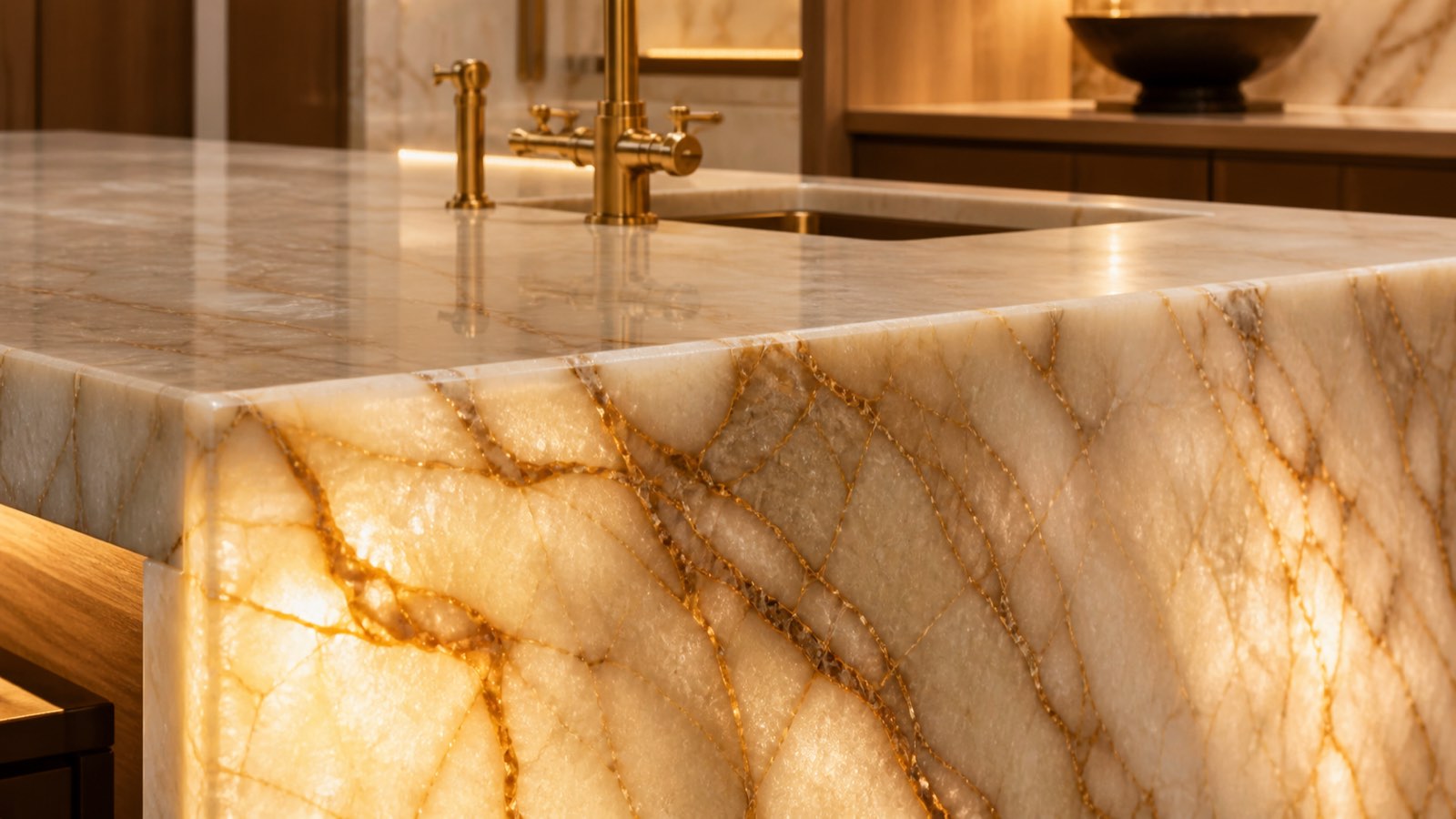
Ask any designer working in Weston or Wellesley what the single most debated material choice is in a luxury kitchen renovation. Every one of them will say the same thing: quartzite or quartz?
It's not a simple question. The two materials look similar in a showroom slab photo, carry similar price ranges, and appeal to homeowners for similar reasons. But they behave very differently in a working kitchen — and the wrong choice can lead to an expensive mistake within 18 months.
We've specified, installed, and warrantied both materials across dozens of projects in eastern Massachusetts. Here's what we actually know.
First: They Are Completely Different Materials
Quartzite is a natural metamorphic rock — sandstone that's been subjected to intense heat and pressure deep underground. It's mined from quarries in Brazil, Italy, Norway, and India. No two slabs are ever identical. Its look comes from millions of years of geological process. It is one of the hardest natural stones used in countertops, rating 7–8 on the Mohs scale.
Quartz countertops (engineered quartz, also called Silestone, Cambria, Caesarstone) are manufactured products — typically 90–95% crushed natural quartz aggregate bound together with polymer resins and pigments. They are engineered in a factory to precise specifications. Every slab of a given color is visually identical. The look is controlled. Mohs hardness: 6–7.
When a homeowner says "I want the look of marble but the durability of quartz" — they're describing engineered quartz. When they say "I want real stone with dramatic veining" — they're describing quartzite. These are different products serving different goals.
The Head-to-Head: What Matters in a Real Kitchen
| Property | Natural Quartzite | Engineered Quartz |
|---|---|---|
| Heat resistance | Excellent — handles hot pans directly (with care) | Poor — resins can discolor above 300°F; trivets required |
| Scratch resistance | Very high (Mohs 7–8) | High (Mohs 6–7) — slightly lower but still excellent for daily use |
| Stain resistance | Moderate — requires sealing every 1–2 years | Excellent — non-porous, requires no sealing |
| Maintenance | Annual sealing, mild cleaners only, avoid acid | Near-zero — wipe clean with soap and water |
| Appearance | Unique — every slab is one-of-a-kind natural variation | Consistent, predictable, designer-controlled |
| UV stability (near windows) | Stable — color does not change in sunlight | Resins can yellow slightly over years with direct sun exposure |
| Installed cost (MA) | $85 – $200/sq ft installed | $65 – $140/sq ft installed |
| Lead time | 2–6 weeks (slab sourcing) | 1–3 weeks (in-stock colors) |
| Book-matching | Yes — spectacular when done well | Limited — patterns are consistent but not natural |
What Top Designers Are Specifying in 2026
Three years ago, the answer would have been split. Engineered quartz dominated the market because of its maintenance-free story and predictable fabrication. Natural quartzite was considered a luxury indulgence.
In 2026, the shift is clear: natural quartzite has become the dominant specification in Massachusetts luxury kitchens at the $250K+ level.
The drivers are several:
- The resin concern: As the first generation of engineered quartz kitchens from 2012–2016 aged, homeowners began reporting yellowing, heat damage near cooktops, and resin degradation near south-facing windows. This has made buyers more skeptical of the "better than natural stone" marketing.
- Natural uniqueness as luxury signal: In a market where two houses on the same street may have been renovated by the same contractor with the same Cambria catalog, book-matched quartzite islands have become a distinguishing element. You cannot recreate them.
- Brazilian quartzite availability: Brazilian quartzite — particularly Calacatta Macaubas, Fantasy Brown, and Super White — has become significantly more accessible in the northeast US market. What once required 8 weeks of import logistics is now available through Boston-area stone distributors in 2–4 weeks.
"When someone in Weston tells me they want a kitchen that's still being talked about in 20 years, we're always sourcing natural quartzite. Engineered quartz will be replaced. A six-foot book-matched Calacatta island will not."
— Nexus Pro Construction
When We Still Specify Engineered Quartz
Honesty matters. Engineered quartz is still our first recommendation in specific scenarios:
- Families with young children: The zero-maintenance story is real. If red wine, juice, and cooking oil land on the counter daily and sealing is not something the homeowner will reliably do, engineered quartz is the right call.
- White or light color consistency: When an architect's design requires exact color matching across countertops, a waterfall island, and floating shelves — only engineered quartz delivers that guarantee. Natural stone will vary slab to slab.
- Budget tier: At $50K–$120K kitchens, the cost difference between premium engineered quartz ($75–$100/sq ft installed) and natural quartzite ($100–$160/sq ft installed) is material. Cambria's Brittanicca range, for instance, delivers a marble look at engineered quartz prices with zero maintenance.
- Dark-colored countertops: Engineered quartz dominates the ultra-dark black countertop category. Absolute Black granite competes, but for true matte black with consistent depth, Silestone Eternal Negro or similar products are superior.
The Materials We're Most Excited About in 2026
For Quartzite
Calacatta Macaubas: White base with dramatic gold and grey veining. Produces spectacular book-matched islands. Cost: $120–$180/sq ft installed. Currently our most-specified luxury quartzite.
Fantasy Brown: Warm beige/brown base with white and burgundy movement. Softer than white quartzites, pairs beautifully with walnut cabinetry. Cost: $95–$140/sq ft installed.
Taj Mahal Quartzite: Warm white with subtle gold veining. The most marble-like of the quartzites with superior durability. Cost: $100–$160/sq ft installed.
For Engineered Quartz
Cambria Brittanicca Warm: Delivers a convincing Calacatta marble look with the consistency and durability of engineered stone. Our most-specified quartz for Tier 1 projects.
Silestone Hybriq+ Series: Newer hybrid technology incorporating 20% recycled content. Environmental story resonates with a segment of Massachusetts buyers. Better heat tolerance than standard quartz.
Our Recommendation
For kitchen projects over $200,000 in Weston, Wellesley, Newton, or Lexington, we recommend natural quartzite for primary surfaces. The investment is higher, the uniqueness is unmatched, and the longevity — properly maintained — far exceeds engineered options.
For secondary surfaces (laundry rooms, butler's pantries, mudroom countertops), engineered quartz makes perfect sense — low-traffic areas where the maintenance-free story matters and the uniqueness premium does not.
For families with children, or kitchens in the $80K–$180K range, premium engineered quartz like Cambria or Silestone is an excellent choice that will serve a home beautifully for 15–20 years.
What we never recommend: cheap engineered quartz from unknown brands. At $35–$55/sq ft installed, these products use lower resin quality that degrades faster and has caused us to walk away from projects we couldn't stand behind.
Let Us Help You Choose the Right Material
We source and install both natural quartzite and premium engineered quartz. During your free consultation, We slab samples directly to your home — so you see how each material looks under your kitchen's actual lighting.
Book Your Free Consultation →