
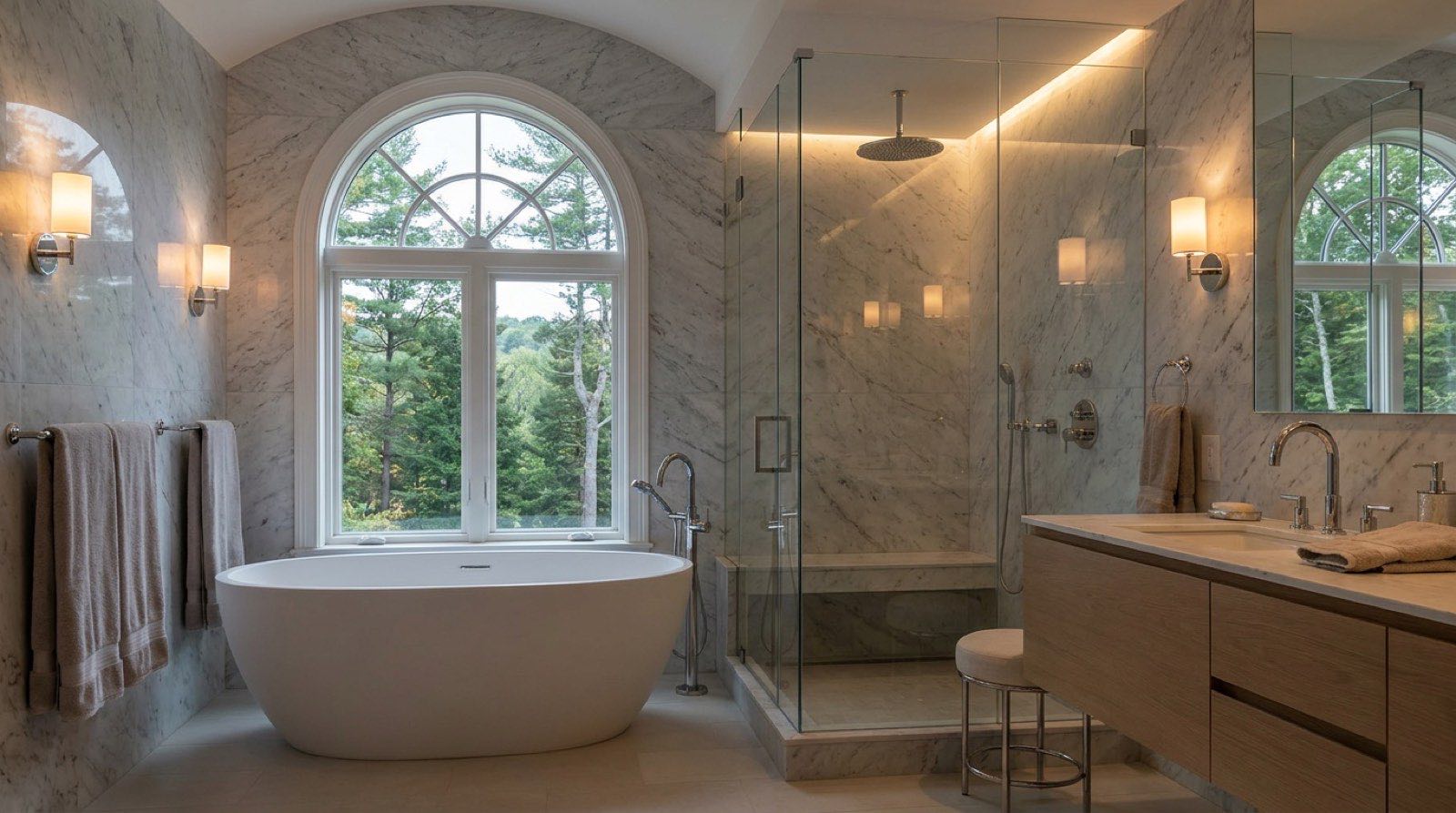
We've been called in to fix other contractors' bathroom renovations more times than we'd like to count. The failures are rarely exotic. They're the same mistakes, made by the same type of contractor, for the same reasons — cut corners, insufficient expertise, and homeowners who chose on price rather than track record.
The dollar figure in our headline is not dramatic. It's accurate. Fixing a failed waterproofing system in a tiled shower typically costs $18,000–$35,000 by the time you demolish the tile, treat the mold, rebuild the substrate, and retile. Fixing a ventilation system that was never properly installed can cost $6,000–$14,000 depending on your home's construction.
Here are the seven mistakes we see most often — and exactly what to ask your contractor before a single tile is installed.
Mistake 1: Inadequate Waterproofing Behind Shower Tile
This is the most expensive mistake in bathroom renovation. Bar none. And it's entirely invisible until the damage is done — typically 18 months to 4 years after installation, when mold appears on adjacent walls or ceilings, or the grout begins cracking and the tile starts to detach.
The problem: many contractors apply tile directly over cement board or Hardiebacker without a proper waterproof membrane. Cement board is moisture-resistant, not waterproof. It will eventually transmit moisture into the framing behind it.
The correct specification for any wet area shower or steam shower:
- Schluter Kerdi membrane or equivalent applied over the entire wet zone (not just the floor pan)
- Kerdi-Band at all corners and transitions
- Linear drain with Kerdi-Drain waterproofing ring at the floor-drain junction
- Full flood test — fill shower floor and bench with 2 inches of water for 24 hours before tile installation to confirm zero leakage
Red flag: Any contractor who says "cement board is enough" or who cannot describe their waterproofing system in detail. Ask specifically: "What waterproofing membrane do you use, and do you flood-test before tiling?" If they hesitate, walk away.
Mistake 2: Installing Oversized Tile in Small Bathrooms
The appeal of large-format tile — 24"×24", 32"×32", even 48"×24" — has been driven by a decade of magazine imagery. And in a large spa bathroom with 200+ square feet of floor area, it's spectacular. In a standard 8×10 master bath, it's a visual disaster that can also create functional problems.
Large-format tile in small spaces creates several issues: the grout lines don't align harmoniously with the room's proportions; cuts at walls result in slivers of tile that look wrong regardless of layout planning; and large tiles require a flatter subfloor — the TCNA industry standard for tiles over 15 inches on their longest dimension is L/720 deflection tolerance, which many older Massachusetts homes cannot meet without subfloor reinforcement.
What we recommend for most primary bathrooms: 12"×24" or 16"×32" rectangular tile for floors and walls. 4"×12" or 3"×12" subway formats for shower walls when a classic look is desired. Reserve the truly large formats (24"+) for bathrooms where the floor area justifies them.
Mistake 3: Under-Specified Ventilation
Massachusetts residential code requires bathroom ventilation. The minimum CFM requirement is calculated at 8 air changes per hour based on room volume. Most standard builder-grade fans — the type installed in 80% of bathrooms — are spec'd at 50 CFM and installed without anyone checking whether they actually exhaust to the exterior (many exhaust into attics, which is a code violation and a moisture catastrophe).
In a luxury renovation, ventilation should be treated as a comfort and longevity system, not a compliance checkbox:
- Steam showers require dedicated steam-rated exhaust fans with heat-rated wiring and a minimum 110 CFM capacity
- Large spa bathrooms (120+ sq ft) should spec 150–200 CFM fans with humidity sensing controls
- All exhaust must terminate outdoors through exterior-rated duct with a backdraft damper — confirmed by your contractor before walls close
- Broan, Panasonic WhisperLine, and Fantech are the brands we trust at the high end
"The bathroom we rebuilt in Newton cost the homeowner $22,000 to remediate. The original renovation was $65,000. The fan exhausted into the attic for two years before mold spread through three ceiling joists. One $400 upgrade would have prevented it all."
— Nexus Pro Construction
Mistake 4: Moving Plumbing Without Structural Assessment
Moving a toilet, relocating a shower drain, or adding a freestanding tub to a location that wasn't previously plumbed sounds straightforward. It rarely is. In Massachusetts homes built before 1980 — which describes the majority of homes in Weston, Wellesley, and Newton — the subfloor and joist configuration was designed around the original plumbing layout.
Common problems when plumbing is moved without proper structural coordination: drilling through load-bearing joists for new drain lines (a structural violation requiring engineering assessment and remediation); insufficient slope on new drain runs resulting in chronic clogging; disrupting existing cast-iron drain stacks that reveal unexpected condition issues; and the discovery of asbestos tape on old pipe joints, which triggers environmental remediation requirements.
What a proper process looks like: Any plumbing relocation should be preceded by a structural assessment of the floor system by a licensed structural engineer or experienced GC. New drain runs should be sized and sloped per IPC code (1/4" per foot minimum), and all work should be inspected by your town's building department before subfloor is closed.
Mistake 5: Ignoring Radiant Heat Under Floor Tile
This is a mistake of omission rather than error — and the cost isn't in fixing something broken, it's in the regret and the cost of adding it later when the tile is already installed.
Electric radiant floor heating under tile is a $1,800–$3,200 add to a bathroom renovation when installed during the project. Adding it after the fact requires demolishing the tile floor, installing the mat, and retiling — typically $4,500–$9,000 in Massachusetts labor and materials.
In a primary bathroom renovation of any significance, radiant floor heat should be standard specification. In our projects, we install Nuheat or WarmUp systems under all primary bath floors as a matter of course. The operational cost is minimal (400–600 watts per hour for a typical bathroom), and the impact on the bathroom experience is transformative — particularly in Massachusetts winters.
Mistake 6: Purchasing Fixtures Before Confirming Rough-In Dimensions
Homeowners who fall in love with a freestanding tub, a wall-mounted toilet, or a specific shower system on Houzz or Instagram often purchase fixtures before confirming that their bathroom's existing rough-in dimensions support those fixtures. This is how expensive mistakes happen.
Wall-mounted toilets require a specific carrier frame installed within the wall, which requires wall depth that most existing walls don't have without full reconstruction. Freestanding tubs require a supply line location that is often in a different position than the existing plumbing rough-in. European-style shower systems (thermostatic valves, ceiling rain heads, body spray) have rough-in requirements that differ significantly from standard American plumbing.
The rule: Never purchase a fixture before your contractor has confirmed the rough-in requirements match your existing conditions — or before they've committed to making the rough-in work as part of the project scope.
Mistake 7: Choosing the Lowest-Cost Contractor for a Luxury Bathroom
This is the mistake that generates all the others. A bathroom renovation in Massachusetts using quality materials and licensed labor should cost $35,000–$85,000 for a primary bath and $20,000–$45,000 for a secondary bath. When a quote comes in at 40% below those numbers, it means one of three things: the materials are lower quality than specified, the labor is unlicensed, or the scope has been quietly reduced.
In the Weston and Wellesley market specifically, we've seen homeowners spend $45,000 with a low-cost contractor and then spend another $35,000 with us two years later to fix it. The materials they chose were real. The craftsmanship was not.
Questions that separate legitimate luxury contractors from those using "luxury" as a marketing word:
- Can I see three completed projects in my town with similar scope and budget?
- Are your tile setters full-time employees or subcontractors?
- What waterproofing system do you use and do you flood-test?
- Is your quote a fixed-price contract?
- What is your warranty on workmanship?
Nexus Pro provides a written 2-year workmanship warranty on all bathroom renovations. We use in-house tile setters who have been with us for years. Every shower gets flood-tested before it's tiled. These are not talking points — they're our process.
Do Your Renovation Right the First Time
The seven mistakes above are all preventable. They don't happen on Nexus Pro projects because we've built the systems to prevent them. If you're planning a bathroom renovation in Weston, Wellesley, Newton, Lexington, or anywhere in MetroWest Boston, we'd love to show you what a properly planned and executed project looks like.
Book Your Free Consultation →